

To re-establish the Sikh Panth as a defining and relevant force on the world stage.
Our Mission: To build what previous generations could only imagine — the infrastructure for a Sikh intellectual and cultural renaissance, grounded in primary sources and original scholarship, reaching youth where they are, and training the scholars, artists, and educators who will carry the tradition forward.
The Panth Deserves Intellectual Foundations as Strong as Its Spiritual Ones
For five centuries, the Sikh Panth has shaped empires, defended the defenseless, and offered humanity a vision of equality the world is still struggling to realize. That legacy deserves a home at the highest levels of global scholarship.
The Panth today faces a gap: advocacy organizations respond to crises, but who provides the long-term intellectual foundations? Gurdwaras serve the sangat, but who helps them become centers of community power? Artists tell Sikh stories, but who ensures those stories are grounded in historical truth?
Harvard Sikh Center exists to fill that gap.
From One Vision to a Global Network
Harvard Sikh Center began with a conviction: the Panth's intellectual traditions deserve a home at the highest levels of global scholarship.
Founded by Dr. Harpreet Singh —a Harvard scholar, author of The Ẓafarnāma of Guru Gobind Singh (Harvard Oriental Series), and co-founder of the Sikh Coalition—the Center has grown into a global network of scholars, fellows, and institutional partners.
Dr. Singh's career embodies the integration of rigorous scholarship and community empowerment. After 9/11, he co-founded the Sikh Coalition, growing it from a volunteer effort to North America's largest Sikh civil rights organization. As Executive Producer for The Story of Sikhs in America (PBS) and advisor for CNN's Emmy-winning United Shades of America, he has shaped how global audiences understand the Panth.
Harvard Sikh Center carries this vision forward — producing the scholarship that empowers the communities it studies.
Through HarvardX’s “Sikhism Through Its Scriptures
Training the next generation
What Guides Our Work
Sovereignty
The Gurus built a Panth that answered to no earthly authority — only the Divine. That spirit of self-determination guides our work: independent scholarship, original frameworks, and leaders who speak with authority, not permission.
Scholarly Rigor
We work with primary sources in their original languages, producing scholarship built to last. The Panth deserves intellectual foundations as strong as its spiritual ones.
Community Empowerment
Rigorous scholarship finds its highest purpose when it empowers the communities it studies. Our work flows from archives to gurdwaras.
Intellectual Independence
We produce research and frameworks that serve the Panth's long-term interests, not short-term politics or the agendas of funders.
Global Vision
The Panth is a global community. Our work serves Sikhs wherever they live — in Panjab, across the diaspora, and in communities yet to form.
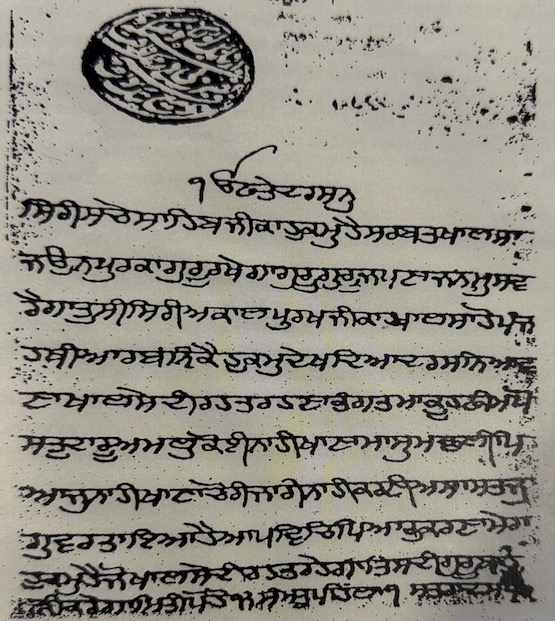
The Seal of Sovereignty
دیگ و تیغ و فتح و نصرت بیدرنگ یافت از نانک گورو گوبند سنگه
deg-o tegh-o fatih-o nusrat be-darang yaft az Nanak Guru Gobind Singh
“The cauldron to nourish the needy and the sword to defend the oppressed, along with victory and steadfast support,
have been granted by Guru Nanak and Guru Gobind Singh.”
This verse first appeared on Sikh royal seals at Anandpur under Guru Gobind Singh, before 1704. When Banda Singh Bahadur established Sikh rule in the Punjab plains in 1710, he adopted this inscription on his seals and coinage — carrying the Guru’s vision of sovereignty into new territory.
The words encapsulate the core principles of Sikh khalsa curriculum.: the cauldron (deg) representing service to the marginalized, the sword (tegh) representing courageous defense of justice.
Our seal honors that unbroken legacy.
The image bearing this seal above is Banda Singh Bahadur’s hukamnama to the Sikh sangat of Jaunpur, issued on December 12, 1710.
Organization Details
Harvard Sikh Center is a 501(c)(3) non-profit organization. We are not affiliated with Harvard University.
Our model draws inspiration from peer organizations such as Harvard Catholic Center and Harvard Chabad — independent organizations serving their communities while maintaining the highest standards of intellectual engagement.
All donations are tax-deductible to the extent permitted by law.
Join the Panth's Intellectual Renaissance
Scholars, artists, educators, and patrons — there's a place for you.
Newsletter Signup
The Panth's Intellectual Renaissance Needs Patrons
Your contribution builds the infrastructure for Sikh scholarship that previous generations could only dream of.