

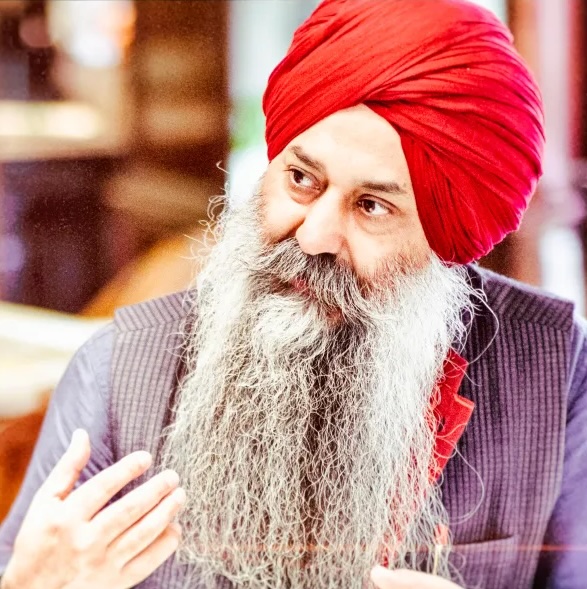
Bhai Baldeep Singh
Founder-Chairman, The Anād Foundation; former Dean, Faculty of Humanities and Religious Studies, Guru Nanak Dev University
| Label | URL |
|---|---|
| Personal Site | https://bhaibaldeep.com |
| The Anād Foundation | https://anadfoundation.org |
| Label | URL |
|---|---|
| https://www.facebook.com/BhaiBaldeep | |
| https://www.instagram.com/bhaibaldeep/ | |
| X | https://x.com/bhaibaldeep |
<p class="font-claude-response-body break-words whitespace-normal" data-sourcepos="35:3-35:897;715-1609">Bhai Baldeep Singh is a vocalist, percussionist, luthier, archivist, and scholar of Gurbāṇī Saṅgīt, the historical musical traditions associated with Gurbāṇī and the music of Guru Granth Sahib. He is the Founder-Chairman of The Anād Foundation, a New Delhi–based nonprofit dedicated to the preservation of South Asia's tangible and intangible heritage, and served as Dean of the Faculty of Humanities and Religious Studies at Guru Nanak Dev University, Amritsar. A thirteenth-generation exponent of the Gurbāṇī kīrtan maryādā, he traces his descent to Bhai Sadharan, a disciple of Guru Nanak.</p> <p class="font-claude-response-body break-words whitespace-normal" data-sourcepos="37:3-37:865;1614-2476">Bhai Baldeep Singh was mentored in the <em>dhrupad</em>, <em>vār</em>, and <em>chant</em> genres of Gurbāṇī Saṅgīt by his granduncles Bhai Avtar Singh (1925–2006) and Bhai Gurcharan Singh (1915–2017), both eleventh-generation exponents of Gurbāṇī kirtan and co-authors of the notated compendium <strong><em>Gurbani Sangeet: Pracheen Reet Ratnavali</em> </strong>(Punjabi University, Patiala, 1979). His comparative training in <em>dhrupad</em> came through Ustad Rahim Fahimuddin Dagar (1926–2011) of the Dāgurvāṇī and Ustad Mohammad Hafiz Khan Khaṅḍehrē Talwaṅḍiwālē (d. 2009) of the Khaṅḍārvāṇī. From the mid-1980s, having set aside an early career in aviation, he undertook nearly two decades of fieldwork across India and Pakistan, documenting the last surviving exponents of the tradition—Sikh <em>kīrtaniye</em>, Namdhari musicians, and Muslim <em>rabābī</em>s—and assembling an archive of several hundred hours of recordings.</p> <p class="font-claude-response-body break-words whitespace-normal" data-sourcepos="39:3-39:710;2481-3188">Beginning in 1988, Bhai Baldeep Singh undertook the recovery of the stringed and percussion instruments of the Sikh Gurus' court, which had ceased to be made after the late 1940s. Working under the guidance of the luthier Gyani Harbhajan Singh of Dandian, Hoshiarpur, he handcrafted instruments including the nomadic (<em>dhrupadi</em>) <em>rabāb</em>, the <em>sarandā</em>, the <em>tāus</em>, the <em>dilrubā</em>, the tamburni (<em>tānpurā</em>), and the <em>jorī</em> and <em>pakhāwaj</em>. He designed new bows for the bowed instruments, handcrafted by Allan Herou in Paris and Nicola Galliena in Milan, and developed a twelve-hour audiovisual presentation, <strong><em>The Musical Instruments of Gurbani and Bhakti Traditions</em></strong>, shown at universities and conservatories internationally.</p> <p class="font-claude-response-body break-words whitespace-normal" data-sourcepos="41:3-41:1083;3193-4273">His scholarship centers on the pedagogy, repertoire, and material culture of Gurbāṇī Saṅgīt. "What Is Kīrtan? Observations, Interventions and Personal Reflections" (<strong><em>Sikh Formations</em></strong>, 2011) argues that four elements—<em>rāga</em>, <em>tāla</em>, <em>shabad</em>, and <em>chitt</em> (intentness)—constitute the performance of <em>kirtan</em>, and that the answers sought in the contemporary revival of "traditional" Sikh music survive in the oral lineages and their pedagogy rather than in written notation, which Gurbāṇī does not contain. The essay documents the historical disruption of these lineages through colonial-era reform, the Singh Sabha movement, and the removal of the <em>rabābī</em> performers from the Darbar Sahib, and it distinguishes an exponent of a living lineage from a musician who reconstructs <em>raga</em> forms from published sources. "Memory and Pedagogy of Gurbāṇī Saṅgīta: An Autoethnographic Udāsī" (<strong><em>Sikh Formations</em></strong>, 2019) extends this argument through the frame of his own transmission within the tradition; it drew a critical response from Pashaura Singh and a published rejoinder from Bhai Baldeep Singh.</p> <p class="font-claude-response-body break-words whitespace-normal" data-sourcepos="43:3-43:744;4278-5019">Through The Anād Foundation, which he established in 2005, Bhai Baldeep Singh directs the ANĀD Archives and Research Center in New Delhi and created the Anād Khaṅḍ: Conservatory of Arts, Aesthetics, Cultural Traditions and Developmental Studies at Sultanpur Lodhi, Kapurthala. He has revived the singing of the twenty-two vārs and has led long-form performance series including <strong><em>Puṅyā Baithak: 31 Ragas in Gurbani</em> </strong>at Qila Sarai, Sultanpur Lodhi (2011–2015), and continues to lead biannual Gurbāṇī Saṅgīt intensive retreats. He directed and produced the documentary <strong><em>Sikh Kīrtan Maryada: The Tradition and Discipline of Spiritual Singing among the Sikhs</em></strong> (1999).</p> <p class="font-claude-response-body break-words whitespace-normal" data-sourcepos="45:3-45:792;5024-5813">Bhai Baldeep Singh has taught, lectured, and performed at institutions including the University of California, Berkeley; the University of Michigan; Hofstra University; Università La Sapienza, Rome; the Conservatory of Hamburg; the Parliament of the World's Religions; and the National Centre for the Performing Arts, Mumbai. He has received the Bhai Batan Singh Memorial Award (1997), the Delhi State Award, the Sikh Gaurav Award (2003), the Kapurthala Heritage Award (2007), and the Punjab State Award (2011); he returned the last in 2015 in protest. From 2009 to 2014 he represented Punjab on the General Council of the Sangeet Natak Akademi, New Delhi.</p>
Gurbāṇī Saṅgīt and the music of the Sri Guru Granth Sahib, including the raga-tala practice, song forms, and repertoire of the Sikh Gurus' court. Sikh musical traditions and performance practice, particularly dhrupad, vār, and chant genres. Oral and pedagogic lineages of Gurbani kirtan and the transmission of intangible heritage. Manuscript, notation, and archival traditions related to Sikh music. Instrument history and reconstruction, including the luthiery of the rabāb, sarandā, tāus, and jori-pakhawaj. The tangible-intangible heritage interface and the recovery of endangered performance traditions.
- gurmat_sangit
- dhadi
- sikh_performance
- sikh_digital_media
- organology
- calligraphy