

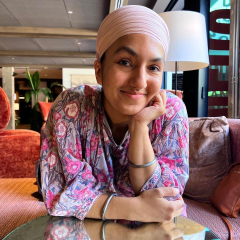
Harleen Kaur
Assistant Teaching Professor of Sociology, T. Denny Sanford School of Social and Family Dynamics, Arizona State University
| Label | URL |
|---|---|
| Personal Website | https://kaurharleen.com/ |
| ASU Faculty Profile | https://search.asu.edu/profile/4440737 |
| Martialing Race (Columbia UP) | https://scholar.google.com/citations?user=5tgPUCQAAAAJ |
<p class="font-claude-response-body break-words whitespace-normal" data-sourcepos="35:3-35:503;740-1240">Harleen Kaur is an Assistant Teaching Professor of Sociology in the T. Denny Sanford School of Social and Family Dynamics at Arizona State University. A sociologist and community organizer, she studies the subjectivity formation of the US Sikh Panjabi diaspora through the intertwined lenses of empire, memory, and the politics of belonging, safety, and recognition. She holds a Ph.D. in Sociology from the University of California, Los Angeles, and a B.A. in English from the University of Michigan.</p> <p class="font-claude-response-body break-words whitespace-normal" data-sourcepos="37:3-37:683;1245-1925">Her first monograph, <strong><em>Martialing Race: How Sikh Sovereignty and Imperialism Shape the Nation State</em></strong>, is under contract with Columbia University Press. The book traces how Sikh embodied sovereignty and community negotiations for safety and recognition have been co-opted into empire- and state-driven tactics of surveillance, militarization, and policing. It develops her broader argument that the "martial race" category inherited from British colonial rule continues to shape Sikh Panjabi investment and implication in the security state — a thread she pursues in "Legacies of a Martial Race: Sikh Panjabi Investment and Implication in the Police State" (<strong><em>Memory Studies</em></strong>, 2023).</p> <p class="font-claude-response-body break-words whitespace-normal" data-sourcepos="39:3-39:1089;1930-3016">Her scholarship joins Sikh studies to critical race and decolonial sociology, drawing on Du Boisian sociology, Frantz Fanon, and Black feminist thought. "Making Citizenship, Becoming Citizens: How Sikh Punjabis Shaped the Exclusionary Politics of Belonging" (<strong><em>Amerasia Journal</em></strong>, 2020) examines how early Sikh Panjabi migrants negotiated racial citizenship in the United States. "The Limits of Imperial Incorporation: Alternative Sociological Frameworks to Study Asian American Subjects" (with Victoria Tran, <em>Sociology Compass</em>, 2023) offers a framework — "extinguishing Asian insurgency" — that reads anti-colonial Sikh diasporic politics, such as the Ghadar movement, against state efforts to incorporate diasporic subjects through militarism. With prabhdeep singh kehal, she co-authored "Sikhs as Implicated Subjects in the United States: A Reflective Essay on Gurmat-Based Interventions in the Movement for Black Lives" (<strong><em>Sikh Research Journal</em></strong>, 2020), which draws on Gurmat and Miri-Piri as frameworks for a Sikh liberation politics in solidarity with the Movement for Black Lives.</p> <p class="font-claude-response-body break-words whitespace-normal" data-sourcepos="41:3-41:970;3021-3988">A significant strand of her work concerns memory, surveillance, and ethnographic method in the wake of anti-Sikh violence. "Im/material and Intimate Relations: Considering Ethnographic Methodologies for Already-Surveilled Communities" (<strong><em>Ethnography</em></strong>, 2024) reflects on her ethnography of a Los Angeles County gurdwara, pursued in response to the 2012 Oak Creek gurdwara shooting, and theorizes such spaces as "already-surveilled" sites where intimacy is entangled with the state surveillance apparatus. Her forthcoming essay "The Specter and Postmemory of 1984 in Western Diasporic Sikh Advocacy" (<strong><em>Sikh Formations</em></strong>) examines how the memory of 1984 is transmitted and mobilized in diasporic Sikh advocacy. Her earlier writing includes "Guru Nanak and the Foundation of Sikhi" (with Simran Jeet Singh, 2016) and a personal essay in <strong><em>Her Name Is Kaur: Sikh American Women Write about Love, Courage, and Faith</em></strong> (edited by Meeta Kaur and Nikky-Guninder Kaur Singh, 2014).</p> <p class="font-claude-response-body break-words whitespace-normal" data-sourcepos="43:3-43:796;3993-4786">Kaur has been active in Sikh community and knowledge-building institutions. She served as a co-editor of the <strong><em>Sikh Research Journal</em></strong>, advises the magazine <strong><em>Kaur Life</em></strong> (a publication for Sikh women and non-binary Sikhs) as its first Assistant Editor, and has helped organize the SAFAR conference on Sikh feminism and research. Her global framework for questions of liberation and sovereignty was shaped in part by a year as a Bonderman Fellow, during which she traveled solo through fifteen countries. Her additional writing has appeared in <strong><em>Feminist Formations</em>, <em>Critical Ethnic Studies</em></strong>, the <strong><em>Journal of Sikh and Panjab Studies</em></strong>, and <strong><em>The Pedagogy of Action</em></strong> (Palgrave Macmillan), and she has reviewed books for <strong><em>Sociology of Race and Ethnicity</em></strong> and the <strong><em>Journal of Sikh and Panjab Studies</em></strong>.</p>
The US Sikh Panjabi diaspora, with emphasis on subjectivity formation through empire, race, and the politics of belonging. The colonial "martial race" legacy and Sikh investment and implication in state surveillance, militarization, and policing. Memory studies, including 1984, postmemory, and the aftermath of anti-Sikh violence such as the Oak Creek shooting. Sikh sovereignty, Miri-Piri, and Gurmat as frameworks for liberation politics. Sikh–Black solidarity and the Movement for Black Lives. Critical, decolonial, and Du Boisian sociology; Sikh feminism; and ethnographic method for racialized and surveilled religious communities.
- diaspora_studies
- sikhs_north_america
- hate_crimes
- sikh_sovereignty
- 1984_studies
- sikh_activism
- gender_studies
- sikh_women
- sikh_identity
- social_justice
- sociology
- postcolonial_studies
- decolonial_studies