

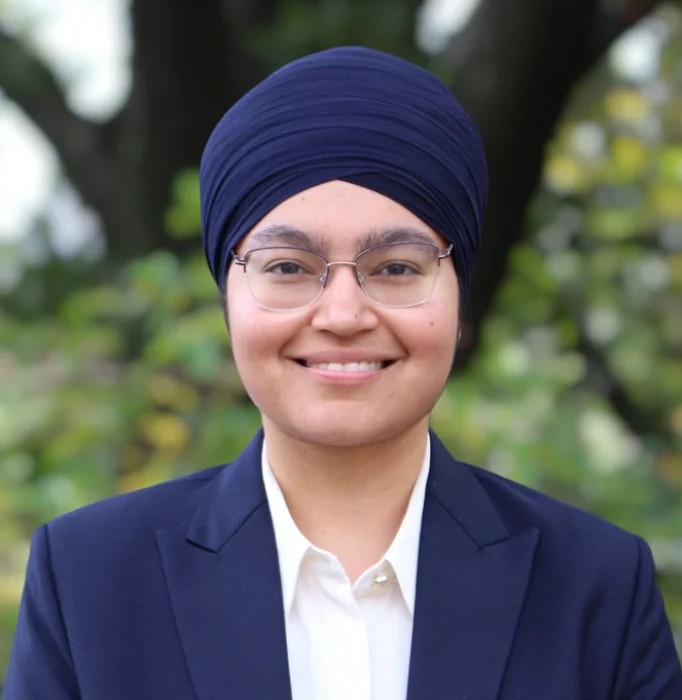
Jalnidh Kaur
Assistant Professor (Lecturer) of Economics, Adam Smith Business School, University of Glasgow
| Label | URL |
|---|---|
| Personal Website | https://www.jalnidhkaur.com/ |
| Research | https://www.jalnidhkaur.com/research/ |
| University of Glasgow (Adam Smith Business School) | https://www.gla.ac.uk/schools/business/ |
<p class="font-claude-response-body break-words whitespace-normal" dir="ltr" data-sourcepos="45:3-45:711;1563-2271">Jalnidh Kaur is an Assistant Professor (Lecturer) of Economics at the Adam Smith Business School, University of Glasgow, and an affiliate of CESifo. A development economist working in the economics of education, she studies how informational and behavioral barriers shape investments in human capital, and how psychosocial tools can be used to overcome adversity in low-income contexts. Much of her work draws on psychology and behavioral economics. She received her Ph.D. in Economics and Education from Columbia University in 2024, an M.Phil. in Economics from the University of Oxford as a Rhodes Scholar in 2015, and a B.A. (Honours) in Economics from St. Stephen's College, University of Delhi, in 2013.</p> <p class="font-claude-response-body break-words whitespace-normal" dir="ltr" data-sourcepos="47:3-47:950;2276-3223">Her research uses field experiments to test how beliefs — a person's sense of their own influence, their expectations of others, and their assessments of ability — affect effort and learning. Her paper "How Much Do I Matter? A Psychological View of Effort and Education Production" examines <strong><em>perceived control</em></strong>, the belief in one's ability to influence outcomes. Through a field experiment, she tests whether a psychological skills curriculum — one containing no references to teaching — can raise teacher productivity. The program increased teachers' willingness to accept performance-linked pay in a real-stakes task, raised teacher effort, and improved student mathematics scores by 0.09 standard deviations, with the largest gains among teachers who began with low perceived control. The work argues that psychological skill-building is itself a dimension of human capital, enabling people to make effective use of expertise they already hold.</p> <p class="font-claude-response-body break-words whitespace-normal" dir="ltr" data-sourcepos="49:3-49:1199;3228-4424">Related projects extend this agenda across South Asia. "Reshaping Beliefs about Ourselves and Others: Experimental Evidence from Civil Servants in Pakistan" (with Daniel Chen) studies a growth-mindset intervention with public school teachers, finding that emphasizing the malleability of student intelligence improved teachers' growth mindset, reduced implicit stereotypes about first-generation learners, and raised student achievement in mathematics, English, and Urdu. "Digital Empowerment for Youth: Experimental Evidence from India" (with Lena Song and Mridul Joshi), conditionally accepted at the <strong><em>Journal of Development Economics</em></strong>, evaluates a curriculum designed to help college students exercise deliberate control over their use of smartphones and social media, measuring effects on mental health, misinformation discernment, sleep, concentration, and academic outcomes. In "Parental Information and Investments in Children's Human Capital," she uses sixteen years of panel data from India to examine how parents' beliefs about their children's ability shape long-run schooling investments, including the decision to keep children in school when the opportunity cost of schooling rises.</p> <p class="font-claude-response-body break-words whitespace-normal" dir="ltr" data-sourcepos="51:3-51:844;4429-5270">Kaur's research has been supported by the Weiss Fund for Research in Development Economics, The Agency Fund, and the Teachers College Economics of Education Program, and has been presented at the NBER Economics of Education meeting, the CESifo Area Conference in Behavioral Economics, PacDev at Stanford, NEUDC at Harvard, the RISE Annual Conference at Oxford, and the European Development Network, among others. Her work has been covered by the World Bank, the International Growth Centre, and Ideas for India. Alongside her scholarship she has taught economics at the University of Glasgow and mentored students in development and education economics. She is affiliated with the Harvard Sikh Center in a strategic and mentoring capacity, supporting interdisciplinary fellows and the Center's development of research and teaching resources.</p>
The economics of education and development economics, with emphasis on low-income contexts in South Asia. How informational and behavioral barriers shape investments in human capital. Psychosocial tools — including perceived control and growth mindset — and their effect on teacher effort, motivation, and student learning. Parental beliefs and long-run investment in children's schooling. The effects of digital technology and social media use on youth wellbeing and academic outcomes. Behavioral and psychological economics. Field experiments and randomized controlled trials as methods for studying education and human capital.
- development_studies
- social_entrepreneurship
- educational_technology
- sikh_education
- sikh_pedagogy
- panjabi_language_ed
- religious_education
- panjab_studies
- panjab_environment
- farmers_movement
- economics
- psychology