

Khalsa Curriculum
- Mughal Imperial Court Dispatch · January 9, 1711
"The Khalsa Sikhs have adopted strange practices. They call a single person an army. In their records, they write that 'an army of the Sikhs' has arrived. They have struck their own coins. In villages, they follow the batai system — giving two-thirds of the produce to peasants and keeping one-third for themselves."
"None knew the Will of God."
— Akhbar-i-Darbar-i-Mualla, daily news dispatch to the Mughal Emperor, translated by Dr. Bhagat Singh. Punjab Past and Present, Vol. XVIII-II, 1984
This is what the Mughal Empire wrote about Banda Singh Bahadur in news reports—not a retrospective history, but an urgent dispatch to the Emperor documenting what terrified them. Your teenager has almost certainly never read it.
You just experienced the curriculum.
That passage above is from the Mughal court’s own news-reporting system — daily dispatches sent to the Emperor. Not a Sikh source claiming greatness. The empire’s own record of what it could not explain.
It documents a revolutionary land reform (two-thirds of produce to the cultivator), an independent coinage, a new administrative vocabulary — all created by a movement the empire was spending millions of rupees trying to destroy.
There are hundreds of passages like this one. Mughal eyewitness accounts. Court records. Diplomatic correspondence. British embassy letters. Coins, hukamnamas, and proclamations — all in archives, most of them never translated for the community they belong to.
The Khalsa Curriculum puts these sources into the hands of Sikh students — and teaches them how to read them.
Source Encounter: Mughal Court Dispatches, 1710
From the Akhbar-i-Darbar-i-Mualla — Read by Emperor Bahadur Shah
May 24, 1710
Khan Bahadur, Abdullah Khan, Shamshir Khan, Anup Singh, and Isa Khan were all ordered to "chastise" Banda Singh. Eight lakhs of rupees were advanced to the imperial forces.
June 22, 1710
Intelligence report: Banda Singh was observed "riding a horse, wearing a brocade dress and carrying in his hand a gun and a spear" — with two thousand five hundred horsemen and ten thousand foot-soldiers.
The empire is conducting daily surveillance of a movement it has mobilized five commanders and eight lakhs of rupees to suppress — and still cannot contain.
December 10, 1710
The Emperor issues a farman seeking the genocide of Sikhs: "Nanak prastan ra har ja kih ba-yaband ba-qatl rasanand" — "Worshippers of Nanak — wherever found, put them to death."
June 22, 1710
Seven days later, the same Emperor reverses himself: "Henceforth, no follower of Nanak is to be accused. Even those who are openly Nanak-worshippers — the jizia shall not be collected from them at double rates, and they shall not be interfered with."
A farman seeking genocide and its partial reversal, seven days apart. The empire's internal contradictions, documented in its own hand.
What a student does with this: These dispatches are not decorations. Students read them alongside the coin inscription and hukamnamas, map the territorial changes, and confront the question: What does it mean when an empire that commands millions of soldiers issues a farman seeking the genocide of a movement it calls “sweepers and tanners” — and then reverses itself a week later? What does that reversal tell you about the empire’s actual position?
The Enemy's Own Eyewitness
Kamwar Khan was a young Mughal court historian physically present at the siege of Lohgarh. His account was never written for Sikh audiences. That's what makes it extraordinary.
On the Sikh soldiers — reported to the Emperor
“Everyone — young and old alike — kept telling the Emperor that this wretch was a master of magic and sorcery, more powerful than the sorcerers of old. Flames shot from his banners and rockets, they said, and his followers could not be wounded by sword or spear. The Emperor, his nobles, and the entire army were gripped with fear and confusion.”
— Kamwar Khan, Tazkiratu’s Salatin Chaghata (c. 1724), trans. Syed Ali Nadeem Rezavi. The Mughal court’s own explanation for why the imperial army could not defeat the Khalsa: sorcery.
The historian's own eyewitness testimony — Lohgarh, 1710
“I was there, in the Prince’s army, and I saw it with my own eyes: one by one, the rebels walked out and fought the Imperial soldiers hand to hand. Each one had to be cut down only after a hard struggle. They killed many of our warriors and wounded many more. And still they kept coming.”
— Kamwar Khan, describing himself watching individual Sikhs — people the empire called “sweepers and tanners” — walk out one by one against professional imperial soldiers and fight to the death
On the devotion of the Sikh fighters — from the empire's most hostile historian
“The Sikhs were mostly on foot. Yet there was not a single man among them — mounted or on foot — who would not throw himself body and soul into the fight, offering his life like a sacrificial goat at the altar of his leader.”
— Khafi Khan, Muntakhib-ul-Lubab. Khafi Khan was one of the most openly hostile Mughal historians toward the Sikhs. This is his assessment of their commitment.
The siege of Gurdas Nangal — what the Sikhs endured, and what the empire admitted
“When the grass ran out, they ate leaves. When the leaves were gone, they stripped bark from the trees, broke off shoots, dried them, ground them into flour, and lived on that. They gnawed the bones of dead animals. Some witnesses claim they saw men cut flesh from their own thighs, roast it, and eat it.”
“And still, says Kamwar Khan, ‘this infernal Sikh chief and his men held out against the entire military force of the great Mughal Empire for eight long months.'”
— Multiple Mughal sources, compiled in Ganda Singh, Life of Banda Singh Bahadur (1935), with Kamwar Khan’s assessment from the Tazkiratu’s Salatin Chaghata
The curriculum question
The empire’s generals claimed their enemy used sorcery. Its historians watched individual Sikhs walk out one by one against professional soldiers. Its most hostile chronicler compared their devotion to sacrificial offerings at an altar. And after eight months of starvation so extreme they stripped bark from trees and ate the bones of dead animals, they still would not surrender. What produces this? And why has no Sikh textbook you’ve ever seen included any of these passages?
Source Encounter: The Coin of Banda Singh Bahadur, 1710
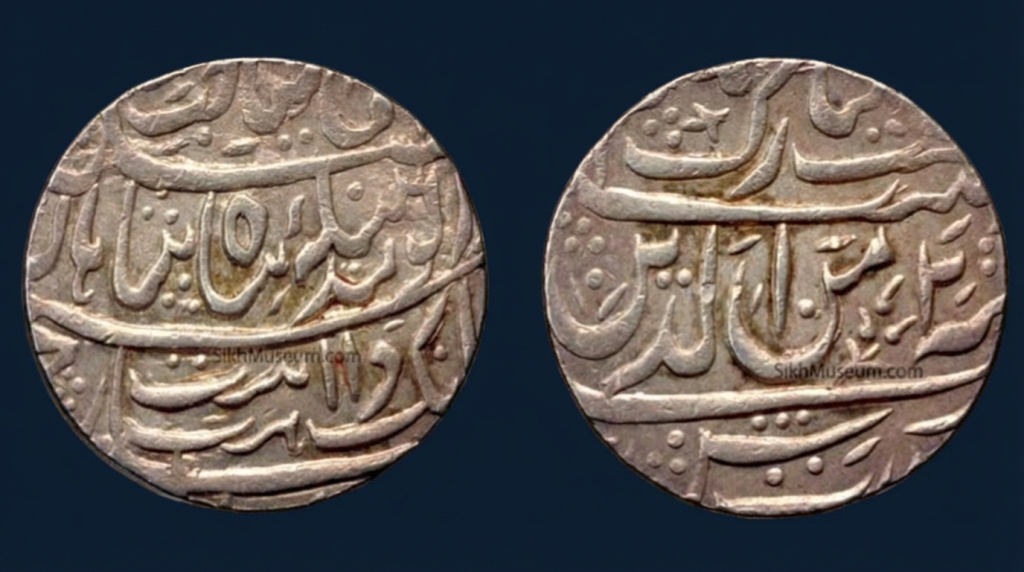
Sikka zad bar har do ālam fazl-i sachā sāhib ast Fateh-i-Gurū Gobind Singh Shāh-i-Shāhān tīgh-i-Nānak wāhib ast
"The sword of the central Doctrine of Nanak destroys the evils of both the worlds — the poverty and slavery on this earth, and the sickness of the soul hereafter — and we hereby proclaim our sovereignty over both the worlds, the seen and the unseen. The final victory in our struggle has been vouchsafed by Guru Gobind Singh, the Harbinger of the good tidings of the ever present Grace of God."
Banda Singh Bahadur minted sovereign coins — not in his own name, but in the names of the Gurus. In Mughal political culture, the right to mint coins was the defining mark of sovereignty. Banda claimed it for the Khalsa — then inscribed it with a declaration of Guru Nanak’s doctrine and Guru Gobind Singh’s victory over both seen and unseen worlds. The Mughal court duly recorded the inscription in their dispatches. These inscriptions did not appear overnight — they had been used on royal seals at Anandpur, the first sovereign Sikh state under Guru Gobind Singh.
Two dispatches. Same empire. Same year.
April 28, 1711 — Akhbar-i-Darbar
“The wretched Nanak-worshipper has made a public promise: ‘I do not oppress Muslims.’ Any Muslim who comes to him receives a daily allowance and wages. He has permitted them to recite the khutba and perform namaz. Five thousand Muslims have gathered around him.”
— Mughal court dispatch documenting Banda Singh’s religious pluralism
October 11, 1711 — Akhbar-i-Darbar
“Forty banjaras, all Nanak-worshippers, were brought in from the districts around Multan. They were told: convert to Islam or die. They refused. They were put to death.”
— The same empire executing forty Vanjara merchants for refusing to convert
In the same year, the same empire documents two facts it finds equally unremarkable: that Banda Singh’s army includes five thousand Muslims receiving daily allowances and the freedom to practice their faith — and that forty Sikh merchants are executed for refusing to abandon theirs. No editorializing is required. The sources speak. The student learns to hear them.
The social revolution — and what happened when the empire crushed it
The court dispatch mentions the batai system — two-thirds of produce to cultivators. Here is what actually happened on the ground, and what happened when it ended.
The social revolution — observed by William Irvine
“In all the districts held by the Sikhs, the reversal of previous customs was striking and complete. A low scavenger or leather-dresser — the lowest of the low in Indian estimation — had only to leave home and join the Guru. In a short time he would return to his birthplace as its ruler, order of appointment in hand. The well-born and wealthy came out to greet him and escort him home. They stood before him with joined palms, awaiting his orders. Not a soul dared disobey.”
— William Irvine, Later Mughals, quoted in Ganda Singh, Life of Banda Singh Bahadur (1935). Irvine was a British civil servant and historian working from contemporary Persian sources.
Independent confirmation — The British Embassy at Delhi, March 10, 1716
“There are 100 each day beheaded. It is not a little remarkable with what patience they undergo their fate, and to the last it has not been found that one apostatised from this new formed Religion.”
— John Surman and Edward Stephenson, letter from the British Embassy to Emperor Farrukh Siyar. A European diplomatic source, independent of both Mughal and Sikh accounts, confirming the daily executions and the absolute refusal to convert.
The execution procession through Delhi — a Mughal eyewitness
“The bazaars and lanes were packed — a crowd like that had rarely been seen. The Muslims could not contain themselves for joy. But the Sikhs, who had been brought to the very edge of destruction, showed not the slightest sign of despair or humiliation. Most of them, riding along on their camels, looked happy — even cheerful — singing the sacred hymns of their Gurus.”
— Muhammad Harisi, Ibrat Namah, eyewitness at Delhi. The crowd came to celebrate. The prisoners sang.
At the execution ground — "The Deliverer"
“Their composure was astonishing. ‘The Deliverer! Kill me first!’ — this was the cry that rang constantly in the executioner’s ears. They had no fear of death. They called the executioner Mukta — the Deliverer.”
“‘What is truly remarkable,’ writes Ghulam Hussain Khan, ‘is that these people did not merely hold steady during the execution — they actually argued and jostled with one another over who would be killed first, and begged the executioner for the privilege.'”
— Multiple Mughal sources, compiled via Irvine and Ganda Singh. Mukta means “the liberated one” — the Sikh term for spiritual liberation. They renamed the executioner.
The curriculum question
A movement of “sweepers and tanners” overthrew the feudal land system, minted sovereign coins, and governed territory from the Yamuna to the Sutlej. When the empire captured them, they sang hymns through the streets of Delhi. They competed for priority in execution. They renamed the executioner Mukta — the Liberated One. Not one, according to Mughal, Sikh, and British sources independently, renounced their faith. What kind of political vision produces this? And what happened to it?
Sources this powerful exist. Nobody has made them accessible.
Everything you've read on this page comes from published academic sources — Mughal court records, eyewitness accounts, British diplomatic correspondence, and scholarly translations that have sat in university libraries for decades. They are as rich as anything available for any figure in early modern world history.
And almost no Sikh student in North America, Britain, or East Africa has ever encountered a single one of them. Not in a Khalsa school. Not in a gurdwara Sunday class. Not in any curriculum available in English or Panjabi.
Three independent traditions — Mughal, Sikh, and European — document the same facts. A movement of the dispossessed seized territory, abolished feudalism, minted coins in the Guru's name, and when captured, went to their deaths without a single defection. The sources agree. The story has simply never been told.
That is the gap the Khalsa Curriculum exists to close.
We are building the first rigorous, engaging, scalable Sikh history curriculum grounded in primary sources — designed for the way this generation actually learns. Every module connects historical scholarship to contemporary questions. Every source is reviewed by scholars. Every student leaves not having memorized a chapter, but having developed a framework for thinking — rooted in their own tradition's documents, connected to the world they live in.
What we're building
A digital curriculum platform — bilingual, AI-adaptive, designed for the flipped classroom — so any Khalsa school teacher, gurdwara volunteer, or parent can facilitate transformative learning.
Primary Sources, Not Summaries
Students engage directly with coins, hukamnamas, court records, and eyewitness accounts. They learn to read sources critically — to ask who wrote this, why, and what's missing.
History as a Living Force
Every historical topic connects to a contemporary question. Banda Singh's land reforms → economic justice. Panjab's water crisis → resource rights. The turban at the job interview → the Guru's call for commitment.
Built for Real Classrooms
The platform handles content delivery through video, adaptive text, and interactive elements. Platform-provided discussion prompts mean no expertise is required to lead meaningful sessions.
Global & Bilingual
Full content in English and Panjabi with Gurmukhi support. Sister Classroom Partnerships connect students from Fremont to Birmingham to Chandigarh. An Annual Virtual Youth Summit brings them together.
Why this hasn't been built before
Khalsa schools and gurdwara Sunday programs do heroic work with volunteer teachers and borrowed materials. The community has not been passive. But the curriculum materials are designed for a previous generation — disconnected from contemporary life and unable to compete with the sophistication of what young people consume everywhere else.
The institutions that once transmitted Sikh identity naturally — the extended family, the village gurdwara, immersion in Panjabi language — have been disrupted by modernity and diaspora. The gap is not effort. It is infrastructure.
We are building what should have been built a generation ago — and we are doing it with the primary sources, the scholarly rigor, and the pedagogical design that this tradition deserves.