
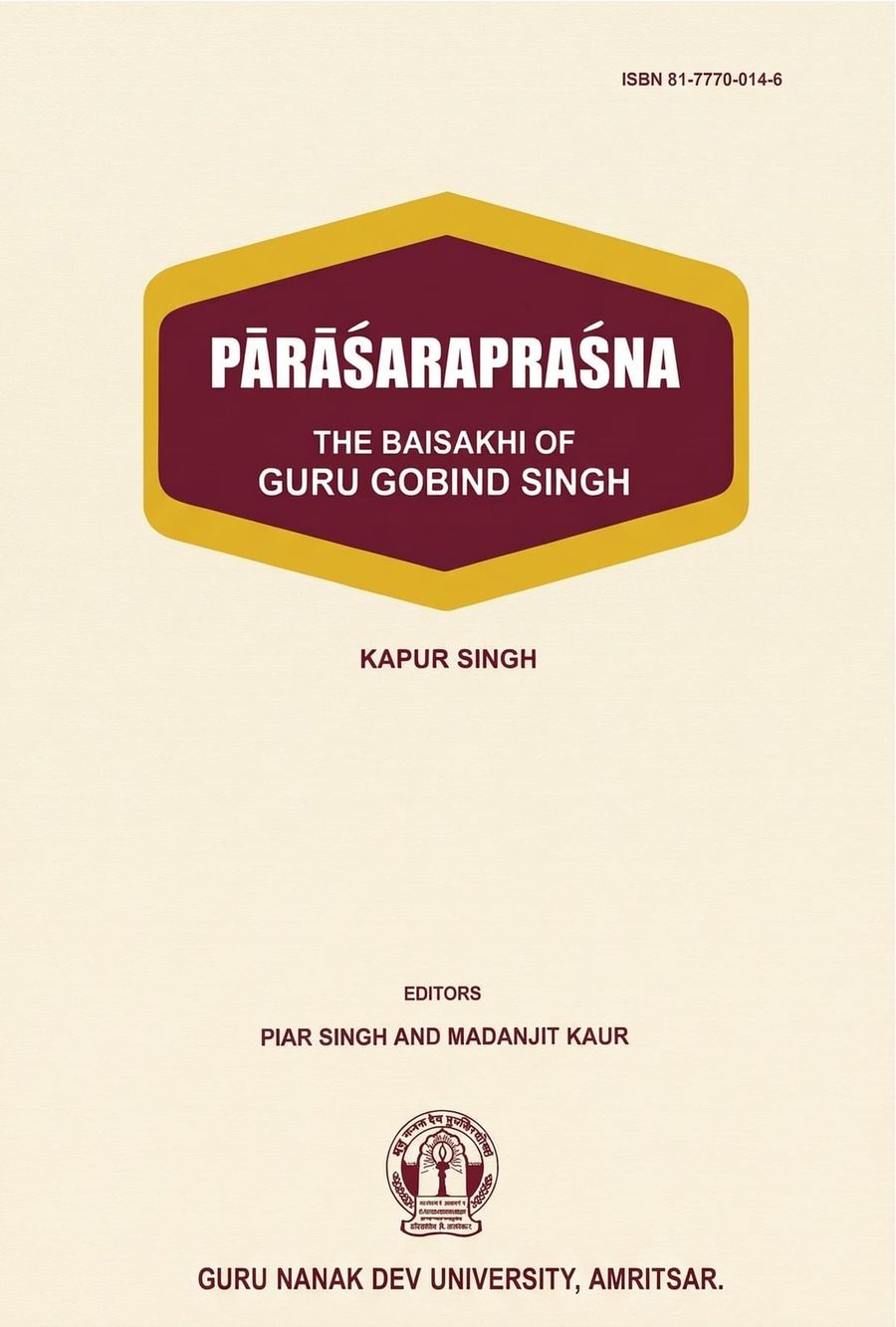
Kapur Singh. 2001. Pārāśarapraśna: The Baisakhi of Guru Gobind Singh. Edited by Piar Singh and Madanjit Kaur. 3rd ed. Amritsar: Guru Nanak Dev University.
Why we recommend it
First published in 1959, Sirdar Kapur Singh’s Pārāśarapraśna: The Baisakhi of Guru Gobind Singh challenges historian Arnold Toynbee’s account of the Khalsa as a response to Mughal power. Kapur Singh traces its founding at Anandpur Sahib in 1699 to a vision already present in Guru Nanak’s teachings, in which spiritual liberation carries obligations for life in society. He reads the initiation of the Five Beloved Ones as a rebirth that prepares them to lead through service, and invokes Thomas Jefferson’s idea of a “natural aristocracy” to describe leadership grounded in virtue and ability. In Guru Gobind Singh’s letters to Aurangzeb, he finds a related demand that rulers be held to the same standards of truthfulness as individuals.
In “The Sikh Raj,” Kapur Singh uses those principles to judge the history of Sikh rule in Panjab. He reads Banda Singh Bahadur’s coinage, which invokes Guru Nanak and Guru Gobind Singh, as a declaration of the Khalsa’s sovereignty. He argues that Maharaja Ranjit Singh weakened that republican tradition by concentrating power at his court and allowing the gurmata, the Panth’s collective resolution, to fall out of use. This is what makes the book distinctive in Sikh studies. It takes the institutions of the Khalsa as a standard for judging the exercise of power, including by Sikh rulers themselves.